
Sharpening TRAVYS passenger segments to steer services and communication

Our Approach
Decisions grounded in evidence
We started with a structured research set-up and a clear aim: capture both the big picture (patterns, recurring needs, emerging segments) and the depth behind it (motivations, pain points, satisfaction drivers). This shared evidence base reduces “gut-feel” decisions and aligns communication and services around real passenger needs.
A survey to surface patterns
We ran an online survey with 85 TRAVYS passengers, combining closed and open questions. The analysis revealed usage patterns, recurring expectations, and friction points - but also more nuanced signals: what triggers the choice of public transport, what creates hesitation, and what builds confidence. These insights shaped our initial segmentation hypotheses.
Segments aren’t defined by frequency alone - but by the reasons people choose public transport, and the conditions that make a trip feel acceptable.
Interviews to uncover the “why”
To turn survey findings into practical levers, we conducted 10 one-to-one interviews to go deeper on the key topics. This connected the quantitative results to real-life realities: daily constraints, trade-offs, moments of doubt, information needs, and trust factors. The outcome was a sharper understanding of barriers and triggers - useful for targeted communication actions and service improvements.
Personas and journeys teams can act on
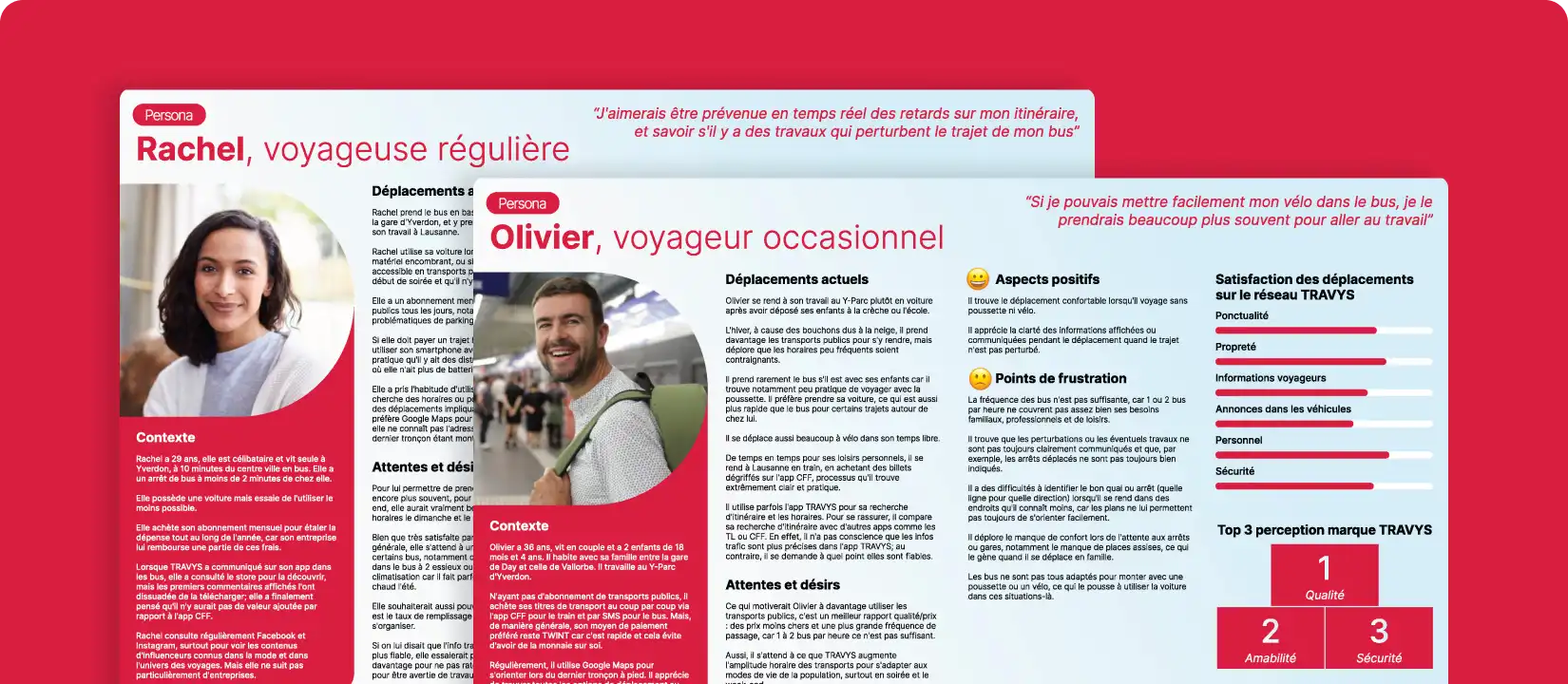
We consolidated the findings into 4 target personas and mapped their end-to-end journeys. The journey maps make critical moments, information needs, and improvement opportunities visible - from “before the trip” to arrival. Deliverables were written to support decisions: which messages to prioritise by segment, which touchpoints to strengthen, and which service improvements will make the biggest difference.
A persona is only useful if it helps you choose: which message for which segment - and which service change will have the most impact.
Key Benefits
Clearer segments for better targeting
4 distinct, decision-ready priority profiles. What it changed for TRAVYS: communication that’s more targeted, more relevant, and aligned with real motivations and barriers.
Journey maps that highlight critical moments
Mapped journeys that reveal frictions, information expectations, and improvement opportunities. What this changes for TRAVYS: clearer priorities across touchpoints and services.
Deliverables that align stakeholders
Personas and journeys used to engage management and teams, and support passenger-centred decisions. What it changed: a shared language - and faster, simpler trade-offs.