

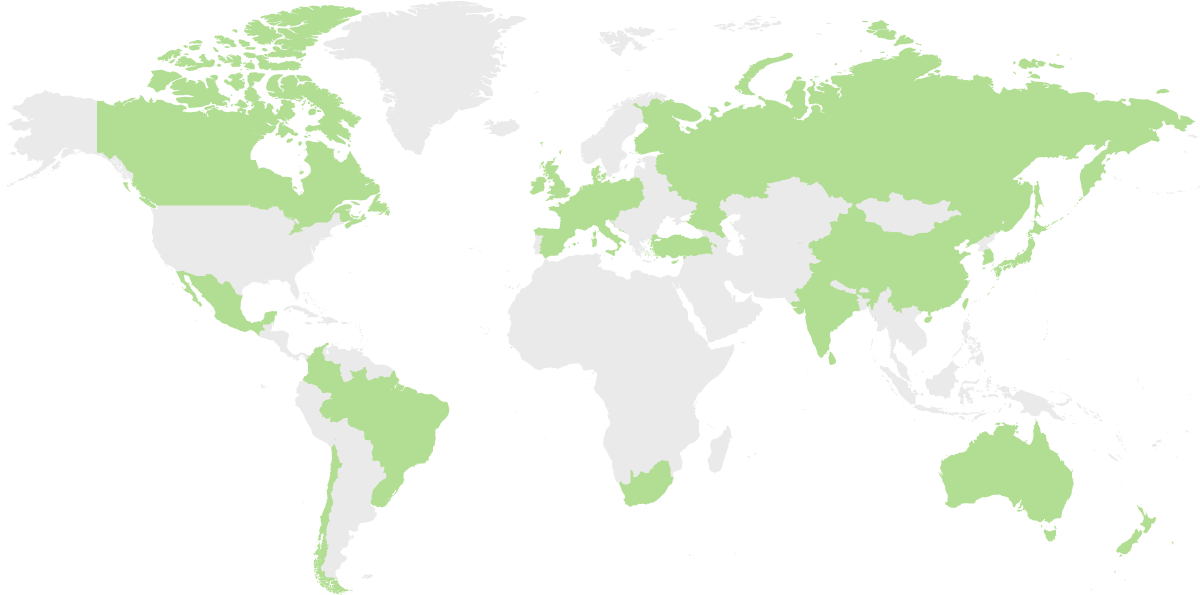
UXalliance, a network of UX agencies in 29 countries across 5 continents.
Why choose UXalliance?
Telono is the Swiss partner of UXalliance, a global network established in 2005 that brings together renowned UX agencies, labs, and experts across multiple continents. In practical terms, this means you gain access to local teams (language, culture, context) with a single point of contact and a consistent methodology for comparing results across countries.

Trusted network
Selected agencies, aligned methods, comparable results.

Simplified management
A single point of contact coordinates everything, giving you clarity.

Local expertise
Studies in the local language, adapted to the cultural and regulatory context.
Localize without losing the ability to generalize
When you launch a service in multiple countries, you have two conflicting needs:
- Localisation (l10n): adapting the experience to a specific market — language, formats, cultural codes, expectations, practices, level of trust, and local constraints.
- Internationalization (i18n): designing a common foundation capable of operating in multiple contexts — structure, content, user journeys, components, and rules flexible enough to be adapted later.
- Effective international user research helps identify what should remain common, what needs to be adapted locally, and how to deploy a consistent experience without ignoring the realities of each market.
Compare properly, decide faster
With UXalliance, you get truly comparable results across countries, because studies are conducted with a common methodology and local teams.
What this means for you:
- Fewer coordination back-and-forths
- Fewer "gut feeling" decisions
- Faster and more defensible product decisions

Why is just translating not enough?

Expression bias

False sense of security

Erroneous cultural interpretation
Biased comparisons
Where is your company located?
In Switzerland
- Adapt user journeys and trust signals
- Identify what is specific vs. universal
- Make decisions before investing heavily
Internationally
- Research and tests in French, German and/or Italian
- Adaptation of formats, currencies, payments
- Multi-market coordination
How does a multi-country project unfold?
Understanding your users' real needs is the starting point for any successful experience. We conduct qualitative and quantitative research to inform your decisions and guide your strategic choices.
Scoping: we define the study objectives, priority markets, and key decisions to inform.
Study Design: we design a common protocol while allowing for the capture of local specificities.
Local Execution: We organize recruitment and testing in the local language, with teams close to the ground.
Consolidated Summary: we analyze the results by country, then build a comparative overview.
Recommendations: we formulate a concrete, prioritized, and directly actionable plan.

Frequently Asked Questions
From how many countries?
When comparing two or more markets, methodological alignment and coordination become a key driver.
What types of studies?
User tests (moderated or unmoderated), interviews, field observation, diary studies, local competitive benchmarking - depending on the markets and your objectives.
Comment articulez-vous enjeux de localisation (l10n) et enseignements globaux?
We analyze market results to identify local specificities (language, conventions, context, constraints), then we produce a multi-country synthesis based on a common protocol, to separate universal pain points from market-specific needs.